

The brass stamping blank is the initial material for various precise parts that are used in electrical, automotive, plumbing, hardware, and industrial applications. The quality of the stamping blank influences the ease of feeding into the press, accuracy of forming, and conformity to the drawing. A suitable blank must therefore provide more than the right alloy and dimensions. Material behavior, thickness consistency, surface condition, edge quality, and forming performance all need to work together.
1. What Material Properties Should a Good Brass Stamping Blank Have?
Suitable Brass Grade and Composition
First of all, there is the matter of brass grade since there are different grades of copper-zinc alloys which vary in strength, ductility, electrical conductivity, corrosion resistance, and machinability. The selected grade should match the forming depth, required mechanical properties, and service environment. Brass material can comprise about 60–70% copper and mostly zinc, whereas lead-free or low-lead brass may be used depending on application regulations.
It is important to get the proper composition and temper of the brass stamping blank since even the slightest deviations may influence the forming process and mechanical properties. In addition, the certificate of material should provide information on alloy grade and composition for every production batch.
Good Strength and Formability
There should be an optimal ratio between strength and ductility in a good brass stamping blank. The material is too hard to form when the loads increase, and cracks occur in sharp bends, whereas the soft material is prone to deformation and loss of dimensions.
For instance, brass sheet has a tensile strength of about 300 – 500 MPa, depending on the alloy used and temper, while elongation values vary significantly between alloys. The specified numbers should be chosen from the relevant material standard, not considered as universal goals.
Reliable Corrosion Resistance
The alloy is resistant to various atmospheric and moisture-related conditions; however, the performance is contingent upon the chemical composition of the alloy and service conditions. Thus, a blank meant for the fabrication of hardware for outdoor applications, plumbing fittings, or electrical parts requires assessment in terms of humidity, chemicals, temperature, and contact with other materials.
2. What Dimensional Qualities Define a Good Brass Stamping Blank?
Dimensional consistency is essential because the blank establishes the amount and distribution of material available during forming. Even with a precisely adjusted press, inconsistent incoming blanks can create variation in finished components.
Consistent Material Thickness
Material thickness influences the forming force, springback, final dimensions, and strength of the product. The brass stamping blank should possess stable thickness both across the surface of the blank and between production batches. In order to give an example, if the drawing calls for 1.00 mm, the manufacturer should control the material thickness in accordance with the applicable standard and tolerance.
Accurate Size and Shape
Blank length, width, diameter, and profile must correspond closely to the production drawing. Dimensional flaws may alter material behavior and lead to incomplete forming, unnecessary thinning, or dimensional drift. In stamping operations where high production rates are expected, dimensional inspection can be performed with the help of calipers, micrometers, optical measuring devices, or automated vision systems. Depending on a particular part, tolerances can be tightly held to a few tenths of a millimeter.
Good Flatness and Edge Quality
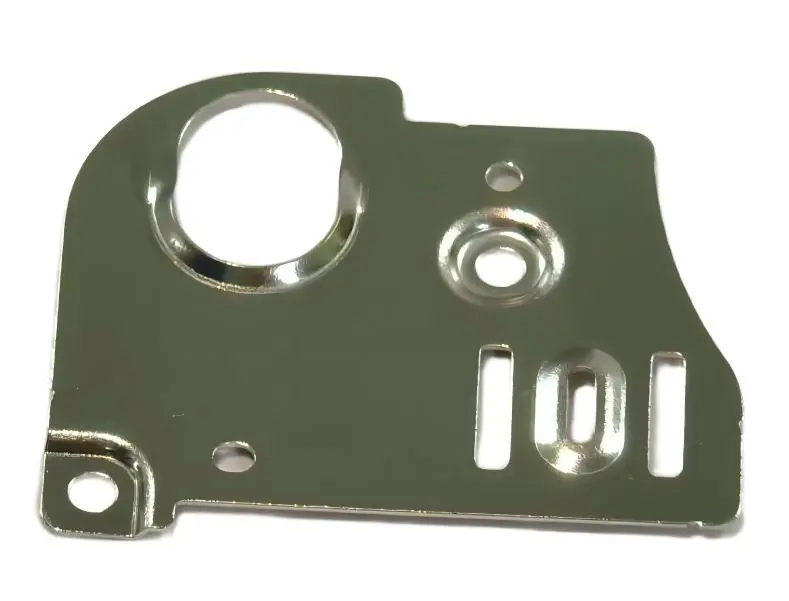
Feeding a straight blank helps achieve better accuracy in placing it into the die. Warping may cause difficulties with proper positioning and feeding, whereas an uneven edge may create additional stresses during material deformation. Moreover, cut edges must be even. Big burrs, tearing, and nonuniform profile can damage the tool and make assembling a part difficult. The edge condition is especially important for such parts as terminals, connectors, clips, and others.
3. What Surface Qualities Should a Good Brass Stamping Blank Have?
Surface condition directly affects production stability and later finishing. The brass stamping blank must arrive clean without defects that would negatively influence material forming, plating, soldering, welding, or assembling.
Smooth and Clean Surface
Arriving material must be free of heavy oxidation, deep scratches, dents, and foreign material included in it. As material undergoes bending and stretching, these defects can become more apparent. Besides, it is very important for electrical or decorative parts since contaminants may adversely affect coatings and contact properties.
Consistent Surface Finish
Predictable results between batches are ensured by a consistent finish on the part of the manufacturer. According to different applications, the material may be required to have a bright, matte, or mill finish before stamping. Surface roughness, if it plays an important role, can be defined on the drawing by a certain Ra value like 0.8 or 1.6 µm. The appropriate Ra value will depend on the finishing process and functional requirements.
Low Burrs and Edge Defects
A sheared edge is always present after blanking; however, a high burr will mean that there are problems with clearance or material control. Controlling the edges of the brass stamping blank may reduce secondary deburring and damage to other equipment.
4. What Performance Should a Good Brass Stamping Blank Deliver?
Material quality should ultimately be judged by how reliably the blank performs in actual production. Laboratory properties are useful, but stable press performance is the practical test.
Stable Stamping Performance
If a brass stamping blank is not uniformly thick, hard, or in good condition, it will cause poor feeding, variability in the dimensions of the stampings, and continual adjustment of the press. The ideal blank allows for consistent material characteristics that ensure a smooth process on every cycle.
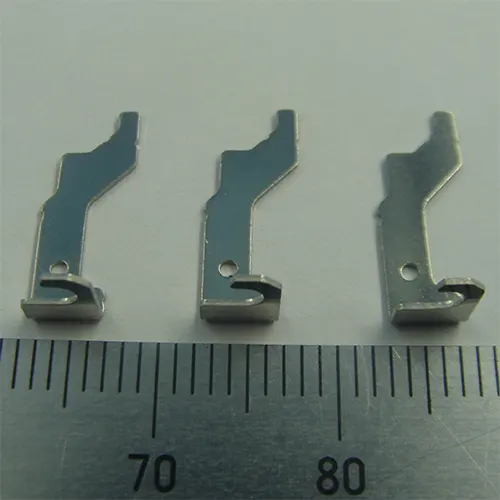
This consistency is crucial for precise electrical parts. Hashimoto Precision’s C2680 Wire Terminal Connector, produced through brass stamping, features uniform dimensions, high strength, and good interchangeability. It demonstrates how stable brass material and controlled stamping can support consistent finished-part quality.

Good Resistance to Cracking and Deformation
The cracking defect arises due to a lack of ductility to accommodate the required amount of deformation, whereas excessive deformation is caused by the softness of the blank and an unsuitable stamping process. Assessment includes trial stamping, measurement, and visual inspection of the bends and drawing areas. Tensile, hardness, and metallographic tests may be needed in case of critical parts.
Consistent Quality During Secondary Processing
The brass stamping blank should remain suitable for bending, riveting, plating, soldering, welding, machining, or assembly after primary stamping. Selection should therefore consider the complete manufacturing route rather than the stamping step alone. A useful quality-control approach is to evaluate several factors together:
| Quality Factor | Typical Control Focus |
| Material | Alloy, temper, chemical composition |
| Thickness | Nominal size and tolerance |
| Dimensions | Length, width, diameter, profile |
| Surface | Cleanliness, scratches, oxidation |
| Edges | Burr height, tearing, profile |
| Performance | Formability, cracking, springback |
For demanding applications, incoming inspection records should be linked to material batches and production lots. This creates traceability and makes it easier to identify sources of variation.
5. Conclusion
A high-quality brass stamping blank should have the correct alloy, proper dimensions, a good surface, reliable edges, and known characteristics during processing. Neither specification alone can define the quality. The right specification is selected according to the part design, stamping process, tolerances, secondary operations, and conditions of use. Combining the information from the material certificate, thickness, dimensions, surface condition, edge reliability, and results of trial stamping will help to avoid defects and ensure more steady production. Should you have any questions about materials, blank quality, or precision stamping technology, please contact Hashimoto Precision.